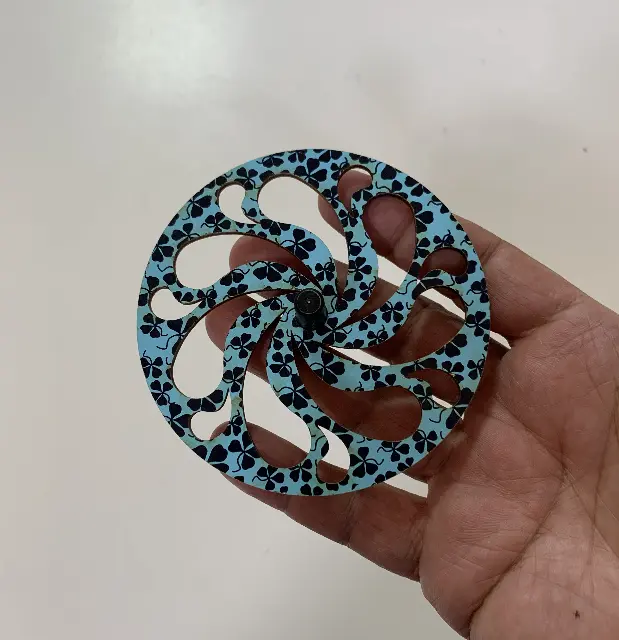
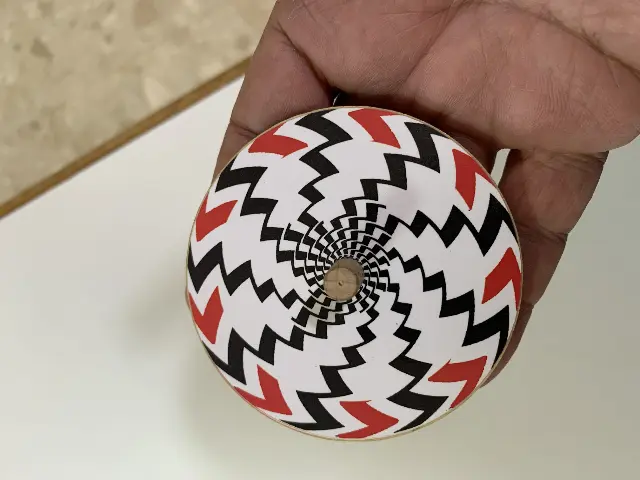
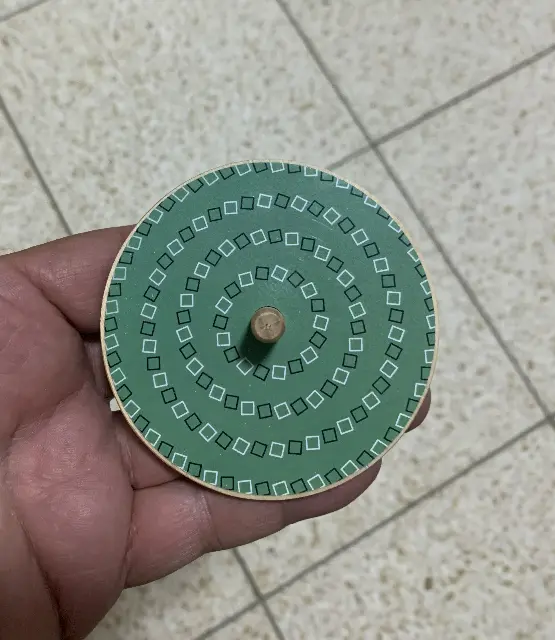
Story behind this top
A Benham disc (or Benham's opt) is a round, white pattern with black lines and segments drawn on it, which, when rotated rapidly around its axis, creates an optical illusion of colors. These colors are called Fechner colors, after the German physicist Gustav Theodor Fechner who first described them. These are not real colors because rotation does not change the color properties of the material, but are entoptic colors, meaning that they originate internally (in the human brain) and not from external stimulation.
The original Benham disc was discovered in 1895 by Charles Benham, an English toy manufacturer who sold discs with the effect. Today, there are many variations of the disc that create a similar effect.
There is no complete explanation for the phenomenon of seeing these colors, the accepted theory is that the reaction times of the three color receptors in the eye (red, green and blue) are different and therefore when white light (which consists of the three colors - red, green and blue), flashes, at different time intervals, the different receptors perceive them at different intervals (and not at the same time) and therefore the brain interprets the information as different actual colors and not as flashing white light.
The Fechner color effect is a color illusion seen when looking at certain patterns that change rapidly or move in black and white. They are also called pattern-induced flicker colors (PIFC). The effect is most often demonstrated with a device called a Benham's top (also called a Benham's disk). When the top is rotated, arcs of pale color are seen in different places on the disk that forms its upper surface. The effect can also be seen with stroboscopic lights when the flashes are set at certain critical speeds. Rotating fan blades, especially aluminum ones, can also demonstrate the effect; as the fan speeds up or slows down, the colors appear, drift, change, and disappear. The fan's steady speed operation does not (usually) produce colors, suggesting that this is not a frequency interference effect.



Comments
I have info on this top