טוען… Loading…
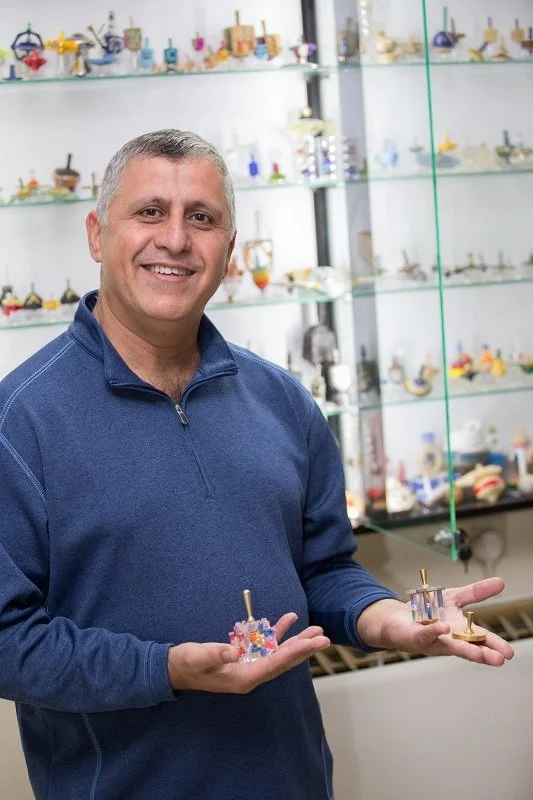
Curator & Collector
Ezra Cohen
Ashdod, Israel · 40+ years
Welcome to the spinning world of Ezra Cohen - the virtual spinning top museum.
"Wait." - Artist Udi Marieuz gave me a collector's dreidel for free, asking only that I donate what I could to any cause I chose. That word turned a Hanukkah habit into a lifelong passion.
SPINNING TOP Ezra (Dreidels) Collection
Public Facebook Group
How I Started Collecting
One of the most common questions I get as a spinning-top collector is: "What made you start?" It goes back to my army service. As a soldier I loved exploring Jerusalem - the most beautiful city in the world, in my eyes. Every Hanukkah I'd wander through Machane Yehuda market and come home with a different dreidel: a tin top with a spring that leaps when you drop it from a height, a self-flipping one that lands upside-down (what collectors call the "Ben-Gurion" top), an olive-wood dreidel, a magnetic tin top whose head spins a little metal snake - each year, something new.
On one Jerusalem visit - I was already married with children - I was walking through the Jewish Quarter toward the Western Wall when I stopped in front of a gallery called "Blue-White." It was founded in 1967 by Alidea Marieuz, the first Jew to settle in the Old City after the Six-Day War. He wove together archaeology, Judaica, and art. In the window stood a dreidel the size of an egg, adorned with colours set inside a transparent resin casting. It stopped me in my tracks.
I walked in. A man of about forty, elegantly dressed, introduced himself as the artist Udi Marieuz - son of the founder, director of the gallery, and chief curator of the Israeli Prime Ministers' art collection. "How much is that dreidel?" I asked, a little shyly. "A hundred dollars," he said. "Every piece comes with a numbered certificate from a limited run - it's made with a new technique, transparent resin cast around embedded pigments." When I heard the price my breath caught. "Too expensive for me," I said, and turned to leave.
"Wait," said a voice behind me. I turned back. "Listen - I don't meet many collectors like you, so I'm going to give you the dreidel. Tomorrow you can donate whatever you'd like to any cause you choose." At first I was flustered, then astonished, then just happy.
That was the turning point. From the moment a collector's dreidel with a certificate joined my ordinary tops, I began seeking out artistic spinning tops from galleries and shops all over the world. The collection grew - and kept growing. Every Rosh Hashana an illustrated New Year's card would arrive from the gallery. Years later, my eldest daughter - an officer on a Jerusalem tour - happened to walk into the gallery and told them about my collection. Udi wasn't there that day, but the person in charge smiled, and sent her home with yet another collector's piece.
The Collection
Today the collection - displayed in Ezra's home in large, illuminated cabinets - numbers more than 1,000 spinning tops that have made their way to him from over 50 countries. Ezra focuses in particular on mechanical tops, with no electronic parts, made from a striking range of materials: warm wood and gleaming metal, delicate ceramic and glass, and pieces in plastic and paper. Together with the family and friends who have been recruited to the cause, he searches Israel and the world for tops in Judaica shops, markets, and fairs - and travels especially to meet the artists and makers in person.
A Restless Curiosity
Ezra is endlessly curious; for him a spinning top is a doorway into an entire world. He studies tops from every angle he can find - history, archaeology, art, Judaism, geography, and even physics and data. And he keeps none of it to himself: every Hanukkah he opens his home to visitors and lectures, and he travels with boxes of tops to schools, kindergartens, and retirement homes. At these gatherings he shares what he has learned and shows that a top can be spun not only with the fingers, but with the palm of the hand, with a string or a manuela, with a breath - and even with a foot.
The Spinning Top Collectors' Association
Out of a deep wish to bring people together, Ezra initiated the founding of the Spinning Top Collectors' Association in Israel. What began as a handful of scattered introductions in 2010 came together formally at the end of 2019 into a living, thriving community. The association, some twenty collectors strong, meets several times a year to trade tops, share ideas, and give back to the wider community. As Ezra likes to put it:
The spinning top creates a connection and bridges between people and children from different places, different cultures, different regions, and different beliefs... a small toy that works wonders.
Spinning Tops Around the World
Many of us know the traditional Jewish Hanukkah dreidel and the letters on its sides - nun, gimel, hey, and pey or shin, for "a great miracle happened here" (or "there"). But spinning tops turn out to exist in cultures, traditions, and countries all over the world, under a great many different names. On the map on this site you can discover those names across dozens of languages - and you may be surprised how many other cultures weave the spinning top into religious practice and local tradition. That story is here on the site too.
Explore the names mapAbout This Museum
The aim of the site you are browsing now is to build a virtual museum of the collection, so that everyone can enjoy its richness, its beauty, and the knowledge gathered around it - from anywhere in the world. The site was created by Ezra together with his son Noam, to connect inventors, makers, artists, and spinning top collectors everywhere, and to share information, impressions, and a shared love for this remarkable object.
Start Exploring
We invite you to set out on a journey through our virtual display.
Browse the Collection
Hundreds of tops to browse and filter by country and material - each with the story behind it, in video and in 3D.
Names Around the World
An interactive world map of what a spinning top is called in 62 languages.
The Play Area
Daily trivia, the Spin Lab, and Top of the World - pin on the map where each top came from.
The Makers
The artists, craftspeople, and companies behind the tops.
Come and discover the magic that comes to life the moment a spinning top begins to turn.
Site designed and developed by Noam Cohen, Ezra Cohen's son.